By Eddie Arenas, CEO of Quarks Data
On June 24, 2026, two earthquakes of magnitude 7.2 and 7.5 struck northern Venezuela 39 seconds apart. In the following days something happened that says a lot about the country: citizen response organized faster than any formal system.
Within days, dozens of platforms built by Venezuelans appeared. Directories of shelters, maps of zones with structural damage, lists of collection centers, channels to coordinate volunteers and transportation. Each one solved a piece of the problem. And a pattern we know well in the data world emerged: lots of initiative, zero integration.
Information was scattered across sites that did not talk to each other. A volunteer with transport capacity did not know which zone needed it. A collection center received one type of supply when it needed another. Anyone wanting to help had to navigate ten platforms to find the right channel. Will did not fail. What failed was the layer meant to connect it.
In an emergency, data is infrastructure
There is an idea we have been repeating for years: the bottleneck is almost never the tool, it is the foundation on which it operates. We have written it about enterprise AI in LATAM, and a national emergency demonstrates it more clearly than any report. When information does not flow, resources do not either. When each platform is an island, a hundred valuable efforts advance in parallel without adding up.
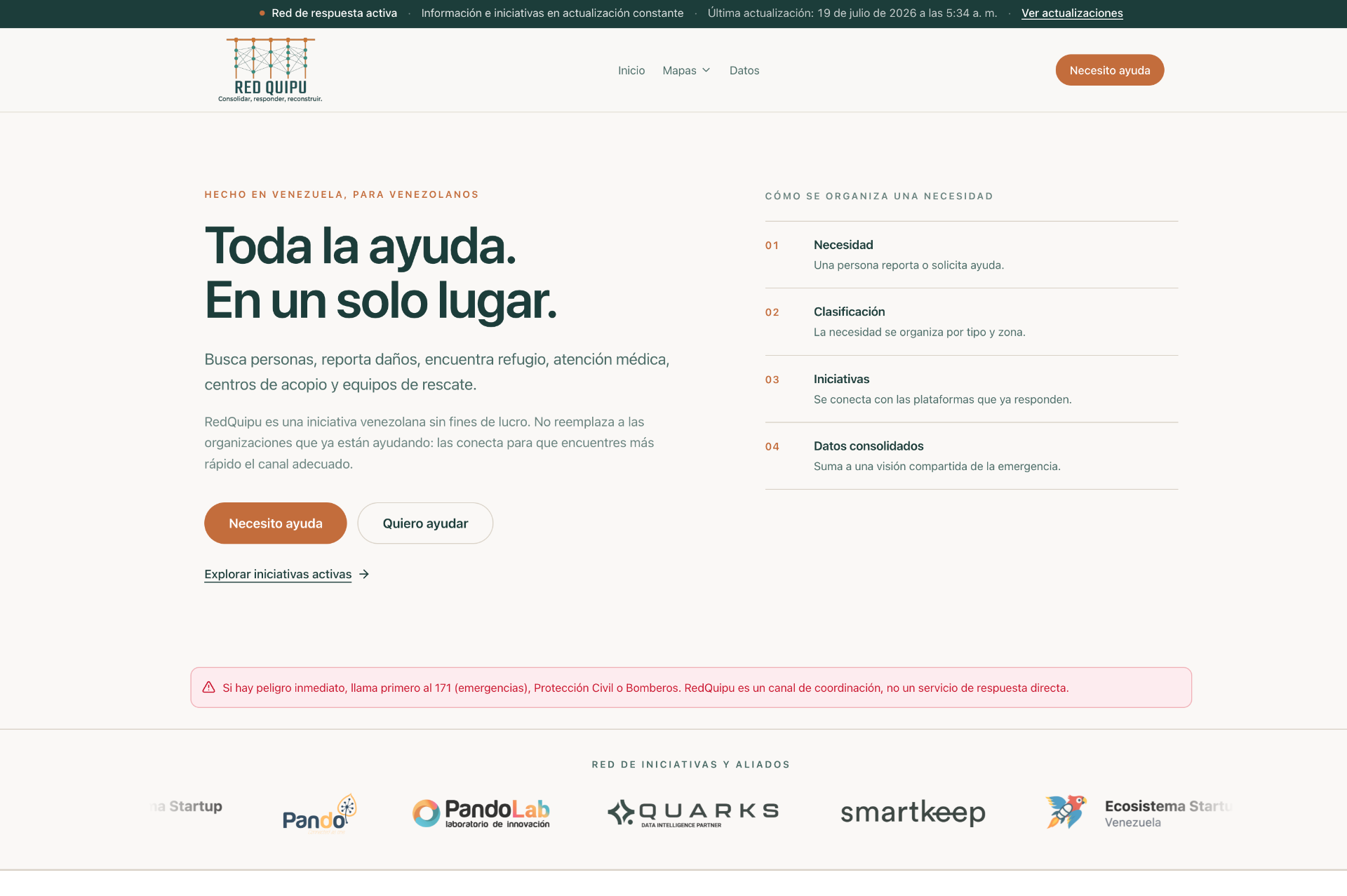
From that observation was born RedQuipu (redquipu.com), a Venezuelan humanitarian platform, free and non-profit, built by teams from the country's tech ecosystem, including Quarks Data and Pando Lab, together with a network of allies. The premise is one: all help, in one place.
The name is not casual. The quipu was the record-keeping system of Andean peoples: knots that encoded information to coordinate a territory. That is what an emergency needs: a point where scattered information becomes a shared view.
What RedQuipu does
RedQuipu does not replace organizations already helping or official emergency services. It connects them. That design principle is executed in three layers:
First, consolidation. The platform gathers active rescue, health, shelter, transport, donation and logistics initiatives into a single directory. Today it connects with more than a dozen citizen platforms and maps 172 active collection centers across 21 states. Someone looking for a help channel does not need to know which platforms exist: they report what they need or offer, and the system directs them to the right place.
Second, classification. Each record is organized by type of need, zone and urgency. An unclassified need is noise. A classified need is a possible decision for whoever coordinates resources.
Third, shared view. Records feed a consolidated data layer that shows where help demand concentrates and what type of response each zone requires. It is information no individual platform can see alone. And because connectivity can also fail, the network deployed internet nodes in hospitals, shelters and critical zones so information keeps flowing where networks failed.
None of this is glamorous or makes headlines. But it is what separates a response that runs out in the first weeks from one that can be sustained over time.
Reconstruction is also a data problem
The emergency phase ends. Reconstruction is just beginning, and will take years. Deciding which zones to prioritize, which structures to assess, where to concentrate scarce resources among the affected states: each of those decisions depends on reliable, organized and accessible information for those who make them.
The data that today helps coordinate the response is the same data that tomorrow can guide reconstruction. That continuity is the deep reason for RedQuipu: it was not designed just for urgency, but as an information foundation that serves the country in the stage that comes next.
What is on us
In the Venezuelan tech ecosystem there is a shared conviction: technology that serves this country is designed from within its context, not despite it. When the context is an emergency, that conviction stops being a phrase and becomes concrete work: integrating systems, structuring information, sustaining connectivity.
RedQuipu is a humanitarian project. It does not sell or share information, does not substitute official emergency services, and exists for one thing: for help and those who need it to find each other faster. It is the contribution of a group of Venezuelan teams that decided what they know how to do, work with data, could also serve here.
Venezuela's reconstruction will need many hands. It will also need good information. That is what we are working on.
If you need help or want to help, visit redquipu.com.